

What Is a CGPA to Percentage Scale?
A CGPA to Percentage Scale is a method used to convert a student’s cumulative grade point average into an equivalent percentage. CGPA stands for Cumulative Grade Point Average and usually represents academic performance across several subjects, semesters, or academic years.
The conversion is useful when an institution, employer, scholarship provider, or application form asks for percentage instead of CGPA. Because universities use different grading systems, the correct conversion method depends on the official policy of the institution awarding the qualification.
- CGPA means Cumulative Grade Point Average.
- Percentage is normally expressed out of 100.
- CGPA measures overall academic performance.
- Conversion changes the reporting format.
- Different institutions use different formulas.
- Some systems use 4-point scales.
- Other systems use 5 or 10 points.
- Official policies should be checked first.
How to Find Your CGPA
Before using a CGPA percentage calculator, find your cumulative CGPA from your latest transcript, marksheet, student portal, or academic record. Make sure you use the cumulative value rather than the GPA for only one semester.
For example, if your transcript shows a CGPA of 3.25 out of 4.00, 3.25 is the value you need for the conversion. If your institution uses a 10-point system and your CGPA is 8.4, enter 8.4 instead.
- Check your latest transcript.
- Find the cumulative CGPA.
- Do not confuse GPA with CGPA.
- Check the maximum CGPA.
- Note the grading scale.
- Write down decimal values correctly.
- Avoid rounding too early.
- Use official academic records.
Identify Your CGPA Scale
The next step is identifying the grading scale used by your institution. Common systems include a 4.0 CGPA scale, 5.0 CGPA scale, and 10.0 CGPA scale. Knowing the maximum value is important because conversion formulas can change according to the grading system.
Different GPA scales are used by educational institutions around the world. A student’s CGPA cannot always be converted accurately by applying the same formula to every grading system. Always identify whether your result is based on a 4-point, 5-point, 10-point, or another scale.
- Identify your grading system.
- Check the maximum CGPA.
- Look for the official grading policy.
- Confirm whether it is GPA or CGPA.
- Note the conversion factor.
- Check your university guidelines.
- Do not assume all scales are identical.
- Keep the original CGPA available.
Find the Correct Conversion Formula
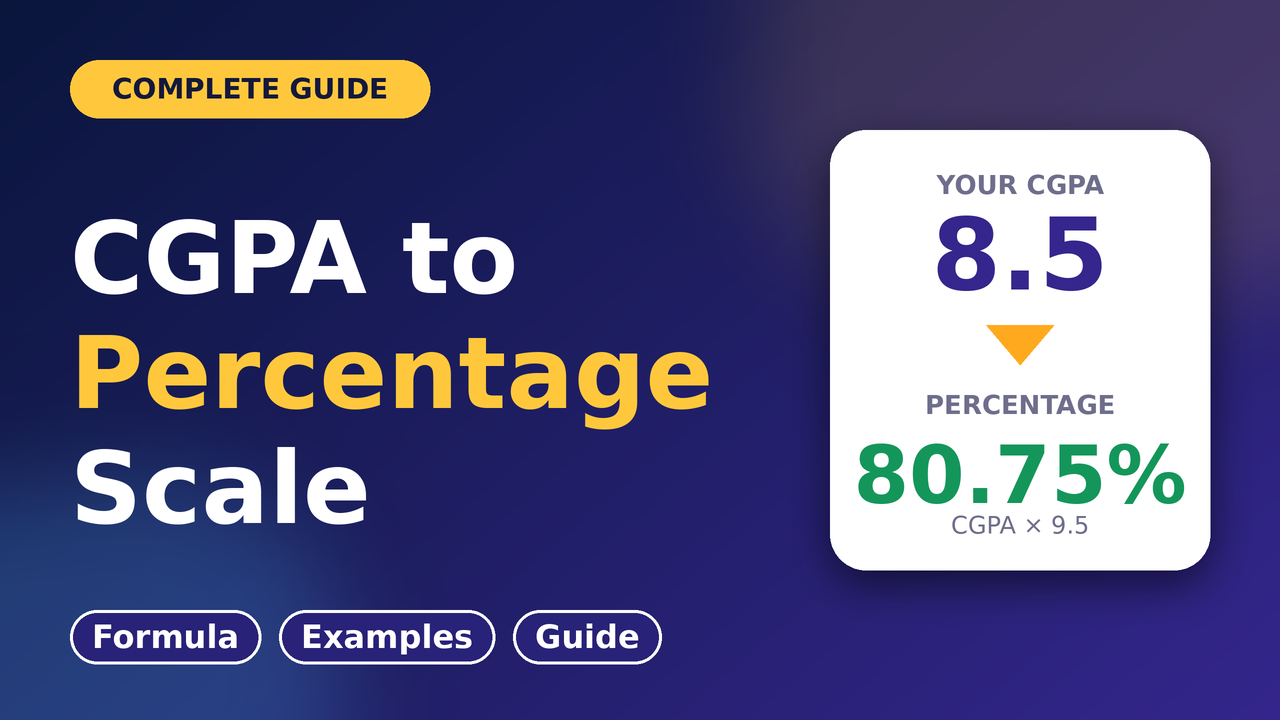
Once you know your CGPA scale, find the formula required by your institution. A commonly used formula is Percentage = CGPA × Conversion Factor. For example, if the approved factor is 9.5 and your CGPA is 8.0, the calculation is 8.0 × 9.5 = 76%.
Another commonly understood method is proportional conversion: Percentage = (CGPA ÷ Maximum CGPA) × 100. For example, 3.2 on a 4.0 scale gives 80% using this method. However, this should only be used when the institution permits proportional conversion.
- Find the official formula.
- Check the conversion factor.
- Enter the correct CGPA.
- Follow the stated calculation.
- Keep decimal places accurate.
- Do not mix different formulas.
- Verify the final answer.
- Follow institutional instructions.
Enter CGPA Into the Calculator
If you are using an online CGPA to percentage calculator, enter your CGPA exactly as shown on your academic record. Then select the appropriate grading scale if the calculator provides multiple options.
Some calculators may ask for a conversion factor instead of automatically selecting one. In that situation, use the factor supplied by your university or examination authority. This helps ensure that the resulting percentage reflects the required academic conversion method.
- Enter your CGPA.
- Select the correct scale.
- Enter the conversion factor.
- Check all numbers.
- Click the calculate button.
- Review the percentage.
- Repeat the calculation if needed.
- Save the result for reference.
Understand the CGPA Percentage Calculation
Understanding the calculation helps you verify whether a calculator has produced a reasonable result. Suppose your CGPA is 7.8 and the approved conversion factor is 9.5. Multiply 7.8 by 9.5, giving a percentage of 74.1%.
For a proportional 4.0 scale, a CGPA of 3.4 would be calculated as 3.4 ÷ 4.0 × 100, resulting in 85%. These examples demonstrate different methods, so students should not use one formula automatically for every institution.
- Example CGPA: 7.8.
- Example factor: 9.5.
- Result: 74.1%.
- Example 4.0 CGPA: 3.4.
- Maximum CGPA: 4.0.
- Proportional result: 85%.
- Formulas can produce different results.
- Official rules determine the correct method.
Avoid Common CGPA Conversion Mistakes
One of the most common mistakes is using an incorrect conversion factor. Students sometimes find a formula online and assume it applies to their university. Another mistake is confusing semester GPA with cumulative CGPA, which can lead to an incorrect percentage.
Rounding the CGPA before completing the calculation can also slightly change the final result. For important applications, use the exact CGPA printed on your transcript and follow the official conversion instructions provided by the relevant institution.
- Do not use an unknown formula.
- Do not confuse GPA and CGPA.
- Avoid early rounding.
- Check the maximum CGPA.
- Confirm the conversion factor.
- Read application instructions carefully.
- Compare the result with official guidance.
- Request a conversion certificate when required.
When Should You Use CGPA to Percentage Conversion?
Students may need CGPA percentage conversion when applying for jobs, scholarships, university admissions, internships, exchange programs, or professional courses. Some application forms specifically provide a field for percentage and do not accept CGPA.
Before entering a converted percentage, check whether the organization requires an official conversion certificate. Some universities and employers may calculate the equivalent themselves or may accept only the percentage stated on an official document.
- University admission applications.
- Scholarship applications.
- Job applications.
- Internship applications.
- Professional programs.
- Exchange programs.
- Academic equivalency requirements.
- Government or institutional forms.
CGPA to Percentage Scale: Final Tips
Using a CGPA to percentage scale is simple when you know your grading system and the correct conversion formula. First identify your CGPA, then check the maximum scale and official conversion method. Finally, calculate the percentage and verify the result before using it in an important application.
Remember that GPA scales and CGPA systems vary between institutions and countries. A formula that works for one university may not work for another. When accuracy matters, always prioritize your transcript, university regulations, conversion certificate, or official examination authority.
- Know your exact CGPA.
- Identify the grading scale.
- Find the approved formula.
- Use a reliable calculator.
- Check your calculation.
- Avoid unsupported conversion formulas.
- Keep official documentation.
- Verify requirements before submitting.
Quick reminder: If your institution provides a specific CGPA-to-percentage formula, that formula should take priority over any general online calculation. Understanding different GPA scales can also help you interpret academic results when comparing institutions.
A CGPA to Percentage Scale is a method used to convert a student’s cumulative grade point average into an equivalent percentage. CGPA stands for Cumulative Grade Point Average and usually represents academic performance across several subjects, semesters, or academic years.
The conversion is useful when an institution, employer, scholarship provider, or application form asks for percentage instead of CGPA. Because universities use different grading systems, the correct conversion method depends on the official policy of the institution awarding the qualification.
- CGPA means Cumulative Grade Point Average.
- Percentage is normally expressed out of 100.
- CGPA measures overall academic performance.
- Conversion changes the reporting format.
- Different institutions use different formulas.
- Some systems use 4-point scales.
- Other systems use 5 or 10 points.
- Official policies should be checked first.
How to Find Your CGPA
Before using a CGPA percentage calculator, find your cumulative CGPA from your latest transcript, marksheet, student portal, or academic record. Make sure you use the cumulative value rather than the GPA for only one semester.
For example, if your transcript shows a CGPA of 3.25 out of 4.00, 3.25 is the value you need for the conversion. If your institution uses a 10-point system and your CGPA is 8.4, enter 8.4 instead.
- Check your latest transcript.
- Find the cumulative CGPA.
- Do not confuse GPA with CGPA.
- Check the maximum CGPA.
- Note the grading scale.
- Write down decimal values correctly.
- Avoid rounding too early.
- Use official academic records.
Identify Your CGPA Scale
The next step is identifying the grading scale used by your institution. Common systems include a 4.0 CGPA scale, 5.0 CGPA scale, and 10.0 CGPA scale. Knowing the maximum value is important because conversion formulas can change according to the grading system.
Different GPA scales are used by educational institutions around the world. A student’s CGPA cannot always be converted accurately by applying the same formula to every grading system. Always identify whether your result is based on a 4-point, 5-point, 10-point, or another scale.
- Identify your grading system.
- Check the maximum CGPA.
- Look for the official grading policy.
- Confirm whether it is GPA or CGPA.
- Note the conversion factor.
- Check your university guidelines.
- Do not assume all scales are identical.
- Keep the original CGPA available.
Find the Correct Conversion Formula
Once you know your CGPA scale, find the formula required by your institution. A commonly used formula is Percentage = CGPA × Conversion Factor. For example, if the approved factor is 9.5 and your CGPA is 8.0, the calculation is 8.0 × 9.5 = 76%.
Another commonly understood method is proportional conversion: Percentage = (CGPA ÷ Maximum CGPA) × 100. For example, 3.2 on a 4.0 scale gives 80% using this method. However, this should only be used when the institution permits proportional conversion.
- Find the official formula.
- Check the conversion factor.
- Enter the correct CGPA.
- Follow the stated calculation.
- Keep decimal places accurate.
- Do not mix different formulas.
- Verify the final answer.
- Follow institutional instructions.
Enter CGPA Into the Calculator
If you are using an online CGPA to percentage calculator, enter your CGPA exactly as shown on your academic record. Then select the appropriate grading scale if the calculator provides multiple options.
Some calculators may ask for a conversion factor instead of automatically selecting one. In that situation, use the factor supplied by your university or examination authority. This helps ensure that the resulting percentage reflects the required academic conversion method.
- Enter your CGPA.
- Select the correct scale.
- Enter the conversion factor.
- Check all numbers.
- Click the calculate button.
- Review the percentage.
- Repeat the calculation if needed.
- Save the result for reference.
Understand the CGPA Percentage Calculation
Understanding the calculation helps you verify whether a calculator has produced a reasonable result. Suppose your CGPA is 7.8 and the approved conversion factor is 9.5. Multiply 7.8 by 9.5, giving a percentage of 74.1%.
For a proportional 4.0 scale, a CGPA of 3.4 would be calculated as 3.4 ÷ 4.0 × 100, resulting in 85%. These examples demonstrate different methods, so students should not use one formula automatically for every institution.
- Example CGPA: 7.8.
- Example factor: 9.5.
- Result: 74.1%.
- Example 4.0 CGPA: 3.4.
- Maximum CGPA: 4.0.
- Proportional result: 85%.
- Formulas can produce different results.
- Official rules determine the correct method.
Avoid Common CGPA Conversion Mistakes
One of the most common mistakes is using an incorrect conversion factor. Students sometimes find a formula online and assume it applies to their university. Another mistake is confusing semester GPA with cumulative CGPA, which can lead to an incorrect percentage.
Rounding the CGPA before completing the calculation can also slightly change the final result. For important applications, use the exact CGPA printed on your transcript and follow the official conversion instructions provided by the relevant institution.
- Do not use an unknown formula.
- Do not confuse GPA and CGPA.
- Avoid early rounding.
- Check the maximum CGPA.
- Confirm the conversion factor.
- Read application instructions carefully.
- Compare the result with official guidance.
- Request a conversion certificate when required.
When Should You Use CGPA to Percentage Conversion?
Students may need CGPA percentage conversion when applying for jobs, scholarships, university admissions, internships, exchange programs, or professional courses. Some application forms specifically provide a field for percentage and do not accept CGPA.
Before entering a converted percentage, check whether the organization requires an official conversion certificate. Some universities and employers may calculate the equivalent themselves or may accept only the percentage stated on an official document.
- University admission applications.
- Scholarship applications.
- Job applications.
- Internship applications.
- Professional programs.
- Exchange programs.
- Academic equivalency requirements.
- Government or institutional forms.
CGPA to Percentage Scale: Final Tips
Using a CGPA to percentage scale is simple when you know your grading system and the correct conversion formula. First identify your CGPA, then check the maximum scale and official conversion method. Finally, calculate the percentage and verify the result before using it in an important application.
Remember that GPA scales and CGPA systems vary between institutions and countries. A formula that works for one university may not work for another. When accuracy matters, always prioritize your transcript, university regulations, conversion certificate, or official examination authority.
- Know your exact CGPA.
- Identify the grading scale.
- Find the approved formula.
- Use a reliable calculator.
- Check your calculation.
- Avoid unsupported conversion formulas.
- Keep official documentation.
- Verify requirements before submitting.
Quick reminder: If your institution provides a specific CGPA-to-percentage formula, that formula should take priority over any general online calculation. Understanding different GPA scales can also help you interpret academic results when comparing institutions.