

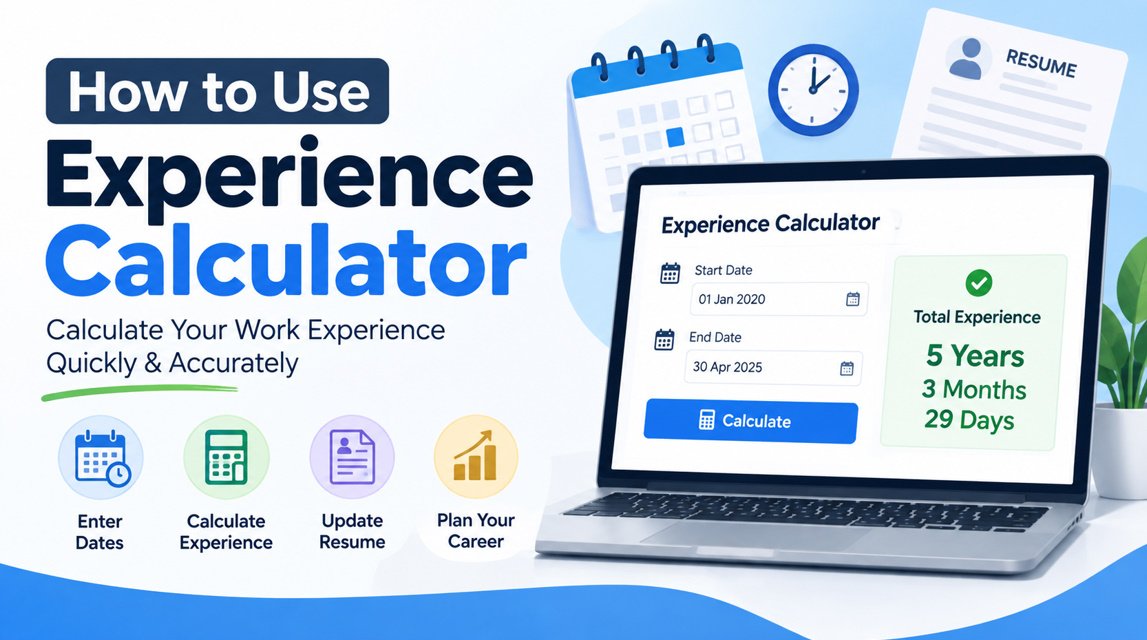
An Experience Calculator is a simple online tool designed to calculate the total amount of professional or work experience between two or more dates. Instead of manually counting years, months, and days, users can enter employment dates and quickly determine their overall experience.
Whether you are preparing a resume, completing a job application, checking eligibility for a position, or maintaining your career records, an experience calculator can save time and reduce calculation mistakes. This guide explains how to use an experience calculator, its benefits, and practical ways to get accurate results.
What Is an Experience Calculator?
An Experience Calculator is a date-based calculation tool that determines how long someone has worked between a starting date and an ending date. Depending on the calculator, it may display the result in years, months, days, or a combination of all three. Some advanced tools also allow multiple employment periods.
The calculator performs the date arithmetic automatically, making it useful for employees, job seekers, recruiters, students, and professionals. By entering accurate joining and leaving dates, users can obtain a clearer picture of their total career experience without relying on manual calendar calculations.
- Calculates work duration
- Uses employment dates
- Shows years and months
- Supports career records
- Reduces manual calculations
- Helps prepare applications
- Improves date accuracy
- Saves valuable time
How Does an Experience Calculator Work?
Most experience calculators require two primary dates: a start date and an end date. The start date represents when employment, training, or another experience period began, while the end date represents when it finished. The tool compares these dates and calculates the elapsed period.
Some calculators provide additional fields for multiple jobs. This feature is especially helpful when a person has worked for different companies or organizations. Each employment period can be entered separately, allowing the calculator to determine the combined experience while helping users organize their professional timeline.
- Enter a start date
- Enter an end date
- Add multiple jobs
- Select the correct dates
- Review calculated duration
- Check overlapping periods
- Compare employment periods
- Record the final result
How to Use Experience Calculator Step by Step
Using an experience calculator is generally straightforward. First, open a reliable calculator and locate the date fields. Enter your employment start date and the relevant end date. If you are currently employed, some tools allow you to select the present date instead of entering a leaving date.
After entering the information, click the calculate button. The tool processes the calendar dates and displays your experience duration. For multiple positions, repeat the process for each employment period and use the total experience feature if available. Always review your entries before relying on the result.
- Open the calculator
- Find date fields
- Enter joining date
- Enter leaving date
- Add another position
- Click calculate
- Review the result
- Save the calculation
How to Calculate Total Work Experience
Calculating total work experience becomes more important when your career includes several employers. For example, you may have worked at one organization for several years before moving to another. An experience calculator can evaluate each period and help you understand the total length of your professional history.
When calculating multiple periods, check whether any employment dates overlap. Counting overlapping employment twice can produce an inflated result. For accurate career calculations, enter each period carefully and understand whether the calculator combines durations automatically or expects you to review overlapping dates manually.
- List every employer
- Record joining dates
- Record leaving dates
- Calculate each period
- Check overlapping employment
- Avoid duplicate periods
- Combine valid durations
- Verify total experience
Benefits of Experience Calculator
One of the biggest benefits of an Experience Calculator is convenience. Manual date calculations can become confusing when employment periods span different months, leap years, or several companies. An automated calculator handles the calendar arithmetic and provides a quick result that is easier to understand.
The tool can also support career planning and professional documentation. Job seekers can use it while updating resumes, completing applications, or determining whether they meet an experience requirement. Recruiters and HR professionals may also use date calculations when reviewing candidate histories and employment timelines.
- Saves calculation time
- Reduces date errors
- Simplifies career tracking
- Supports job applications
- Helps update resumes
- Handles multiple periods
- Improves record keeping
- Makes results easy to read
Experience Calculator for Jobs and Resumes
An experience calculator can be particularly useful when preparing a resume or CV. Instead of estimating your professional experience, you can calculate employment durations from actual joining and leaving dates. This helps you present career information more consistently and confidently.
For job applications, accurate experience information can also be important when a vacancy specifies requirements such as two years, three years, or five years of relevant experience. Although employers may interpret experience differently, a calculator can help you understand your own employment timeline before entering information into an application form.
- Check total experience
- Update your CV
- Verify employment dates
- Prepare job applications
- Understand career length
- Track relevant experience
- Review professional history
- Avoid unsupported estimates
Common Mistakes When Using an Experience Calculator
Even a reliable calculator cannot correct incorrect information. One common mistake is entering the wrong joining or leaving date. Another is accidentally reversing the dates or including a period twice. Users should carefully compare the calculated result with their employment documents and personal records.
Another important issue is overlapping employment. Someone may work two jobs during the same period, and simply adding both durations may not represent their chronological career length. The appropriate calculation depends on the purpose of the calculation, so always understand what the final figure is intended to represent.
- Avoid incorrect dates
- Check date order
- Prevent duplicate entries
- Review overlapping periods
- Confirm job records
- Check the displayed result
- Use consistent information
- Recalculate when needed
Tips for Getting Accurate Experience Results
Accuracy starts with reliable source information. Use official employment records, offer letters, contracts, relieving documents, or other personal career records when entering dates. Avoid relying on memory if precise dates are available, especially when calculating experience for an important application.
It is also helpful to keep a personal employment timeline. Maintain a simple record containing employer names, joining dates, leaving dates, job titles, and relevant responsibilities. Updating this information whenever your employment changes makes future experience calculations much faster and more reliable.
- Use exact dates
- Keep employment records
- Check calendar details
- Review every entry
- Maintain a career timeline
- Verify multiple jobs
- Recalculate important results
- Keep records updated
Who Should Use an Experience Calculator?
An Experience Calculator can benefit almost anyone who needs to measure time spent in employment, internships, projects, training, or other professional activities. Job seekers can use it to prepare accurate application information, while employees can monitor their career progress and maintain organized professional records.
Students and early-career professionals may also find the tool useful when tracking internships, apprenticeships, part-time employment, or relevant practical experience. HR teams and recruiters can use date calculations as a supporting tool when reviewing employment histories, although final eligibility decisions should follow the employer’s specific requirements.
- Job seekers
- Employees
- Freelancers
- Interns
- Students
- Recruiters
- HR professionals
- Career planners
Why Experience Calculator Is Better Than Manual Calculation
Manual calculation requires users to count calendar periods carefully and account for differences between months. This can become tedious when several employment periods are involved. An online experience calculator automates much of this work, making the process quicker and easier for everyday career planning.
However, an experience calculator should be viewed as a calculation aid rather than a replacement for official employment records. The tool can tell you the duration between dates, but organizations may have their own definitions of relevant experience, full-time experience, internship experience, or qualifying professional service.
- Automates date arithmetic
- Reduces repetitive work
- Handles calendar differences
- Supports multiple periods
- Produces quick results
- Simplifies career planning
- Helps verify estimates
- Complements official records
Final Thoughts on Using an Experience Calculator
An Experience Calculator provides a practical way to determine work duration without complicated manual date calculations. By entering accurate employment dates, users can quickly estimate years, months, and days of experience and maintain a more organized professional timeline.
For the best results, always verify dates, review multiple employment periods, and watch for overlapping jobs. Whether you are updating a CV, applying for a position, tracking internships, or organizing career records, an experience calculator can make professional experience calculations faster, clearer, and more convenient.
- Enter accurate dates
- Check every result
- Track career history
- Review job periods
- Avoid duplicate counting
- Keep records organized
- Use the tool consistently
- Verify important calculations